🌳 Bush vs. Healthy Tree: Why Structure Matters! ✂️
Ever look at a tree and think it looks more like a giant, messy shrub? Or notice a tree that seems to be splitting down the middle?
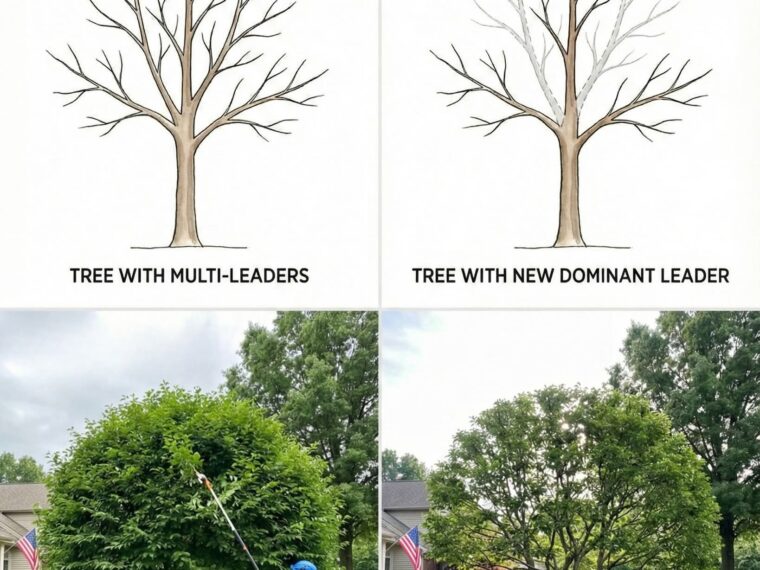
Check out this “Before & After” and the diagram above. This is a perfect example of why Structural Pruning is essential for the long-term health and safety of your trees.
Here is the breakdown of what is happening in these photos:
- The Diagram: The “Two-Headed” Monster 📏
The Problem: When a tree has multiple leaders (stems) growing straight up next to each other, they develop “weak crotches.” As they get heavier, they are highly prone to splitting apart during wind storms.
The Fix: We identify the strongest central stem and remove the competitors. This forces the tree to put energy into one strong trunk, creating a stable architecture.
- The Photos: From Cluttered to Clean 🌿
Before: The tree is dense and congested. Air cannot flow through it (inviting fungus), and sunlight can’t reach the inner branches. It catches the wind like a sail.
After: We performed a “Crown Thinning.” Now, wind passes through the canopy, and sunlight reaches the grass below.
💡 3 Expert Tips for Homeowners:
- Don’t “Lion Tail” Your Trees! 🦁 Notice in the “After” photo that we didn’t just strip the branches bare? We left foliage distributed along the entire branch. If you remove all inner leaves and only leave a tuft at the end (like a lion’s tail), the branch becomes weak and more likely to snap in the wind.
- The 30% Rule 📉 It might look like we took a lot off, but we are careful! A good rule of thumb is never to remove more than 25-30% of a tree’s living foliage in one season. Taking too much stresses the tree and can cause it to panic-grow “water sprouts” (those ugly vertical sticks).
- Timing is Everything ⏰ While major structural changes are best done in late winter when the tree is dormant, light thinning and deadwood removal (like in this photo) can be done in summer to improve air circulation and reduce weight on heavy limbs.
Does your tree look like the “Before” picture? It might be time to schedule an assessment. Proper pruning now prevents storm damage later!