🌿✂️ The Secret to Perfect Lavender: Stop the “Woody Leggy” Look!
Is your lavender starting to look like a bundle of dry sticks with just a few flowers on top? That’s the dreaded “woody” look, and it happens when we’re too afraid to prune!
Here is the ultimate guide to pruning lavender (verified and tested!) to keep it lush, round, and blooming year after year. 👇
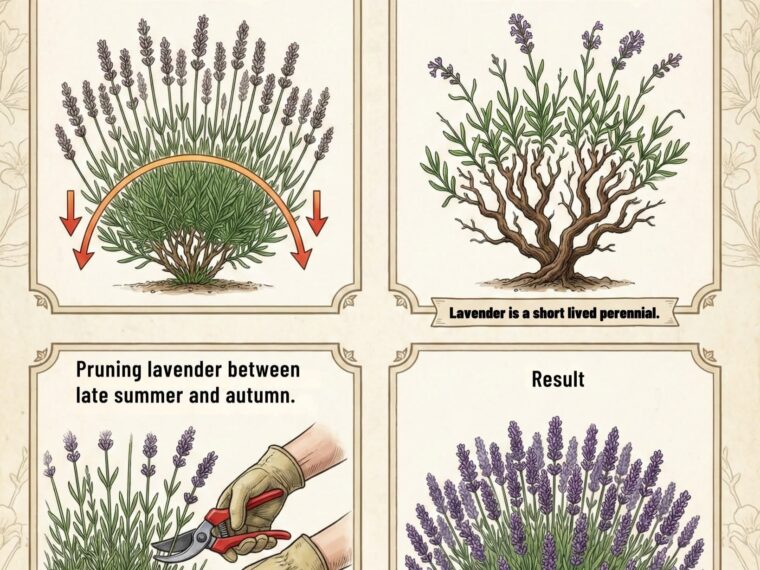
- WHY DO WE PRUNE? (Top Right Image)
Lavender is naturally a “short-lived perennial.” If you leave it alone, it grows woody, thick trunks at the base that won’t produce new leaves. Once it gets leggy and splits open in the middle, it’s very hard to fix.
The Goal: You want to force the plant to grow thick, compact foliage rather than long, woody branches.
- WHEN TO PRUNE? (Bottom Left Image)
Timing is everything!
The Sweet Spot: Late summer to early autumn (right after it finishes flowering).
Why? You want to give the plant enough time to heal its “wounds” before the winter frosts hit. If you prune too late in winter, the frost can damage the cut stems.
- HOW TO PRUNE (Top Left Image)
This is the part that scares people, but simply follow the “Mound Rule.”
The Shape: Visualize a semi-circle or mound shape (see the orange line in the graphic).
The Cut: Take your garden shears and cut back about 1/3 to 1/2 of the green growth.
⚠️ CRITICAL WARNING: Do NOT cut into the old, brown, woody part of the stem (the part with no leaves). Lavender generally cannot regrow from old wood. If you cut down to the brown sticks, that branch will likely die. Always leave a nice layer of green leaves below your cut.
- THE RESULT (Bottom Right Image)
By being brave with your shears in the autumn, you stimulate the plant to send out fresh, vigorous energy in the spring. You get that stunning, dense purple hedge look instead of a straggly bush!
Summary Checklist:
✅ Wait until flowers fade (Late Summer/Autumn).
✅ Shape into a rounded mound.
✅ Cut the green stems, but stay out of the brown wood!
✅ Give it a good drink of water after a hard prune.